Do you actually know what your dog does the moment you close the front door? Most owners don't — and the uncertainty can be genuinely unsettling. According to PDSA, separation-related problems are extremely common in dogs, causing everything from destructive chewing to prolonged howling. A pet collar camera removes the guesswork entirely — you press record before you leave, and when you return you see exactly what happened, minute by minute, from your dog's own perspective.
The problem isn't limited to dogs left home alone. Outdoor cats face a different set of unknowns every time they slip through the cat flap. PDSA recommends microchipping, neutering and supervised introductions before letting cats roam — but even the most careful owner has no idea where their cat actually goes, what they chase, or how far they travel once they're out of sight. A collar-mounted camera answers every one of those questions with real footage rather than assumptions.
This guide covers everything you need to know about pet collar cameras — how they work, the five biggest benefits for dogs and cats, which breeds benefit most, step-by-step setup instructions, and a full comparison against home pet cameras and action cameras. Whether you want to monitor a nervous dog's alone-time behaviour or simply capture your cat's secret adventures, we'll help you understand exactly what to look for. As Dogs Trust explains, recognising stress signals early is key to preventing behavioural problems — and reviewing collar camera footage is one of the most effective ways to spot signs you'd otherwise miss. Our own CozyPaws™ Pet Collar Camera was designed with exactly this in mind: 1080P HD video, a 160° ultra-wide lens and electronic image stabilisation in a body that weighs just 26.4 grams.
Table of Contents
- How a Pet Collar Camera Works
- 5 Benefits of Using a Pet Collar Camera
- Is a Pet Collar Camera Safe for Dogs & Cats?
- Which Pets Need a Collar Camera Most?
- How to Use Your Pet Collar Camera
- Pet Collar Camera vs Alternatives — Full Comparison
- Frequently Asked Questions
1. How a Pet Collar Camera Works
A pet collar camera is a compact, lightweight recording device that mounts directly onto your dog's or cat's collar. Unlike home pet cameras that sit on a shelf and film one fixed angle, a collar camera travels wherever your pet goes — capturing their entire day from their own point of view. The concept is simple: strap it on, press record, and retrieve the footage when they're done. No WiFi connection, no phone app, no monthly subscription — just a self-contained camera that records to a memory card.
The Camera Module
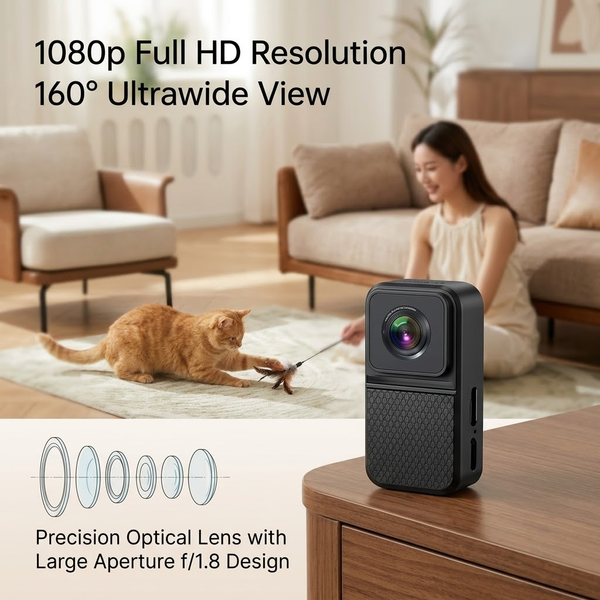
The core of any collar camera is its lens, sensor and processor. The CozyPaws™ Pet Collar Camera uses a 160° fisheye wide-angle lens paired with a 1/2.6-inch GPCV1247 image sensor. This combination captures a field of view roughly 85% wider than a standard 90° camera lens, meaning the footage includes peripheral details — other dogs approaching from the side, birds overhead, furniture at the edges of a room — rather than just a narrow tunnel straight ahead. Video records at 1920×1080P (Full HD) in AVI format at 30 frames per second, while photos capture at 2560×1440 for extra detail when you want to zoom in on a still frame.
Image Stabilisation & Audio
Pets don't walk in smooth, steady lines. They dart, spin, sniff and pounce — which turns most collar camera footage into an unwatchable blur. Electronic Image Stabilisation (EIS) solves this by compensating for sudden movement in real time, producing noticeably smoother video without post-editing. A built-in microphone records ambient sound simultaneously, so you hear what your pet hears — other animals, traffic, household noises, or the silence of an empty house.
The Mounting System & Storage
The camera sits inside a low-profile mounting bracket that attaches to an adjustable nylon collar strap. The entire unit — camera plus bracket — weighs just 26.4 grams, lighter than two £1 coins, so it doesn't pull, swing or interfere with natural movement. All footage records directly to a microSD card (up to 256 GB), which you remove and read via the included USB card reader — or connect the camera directly to your computer via USB Type-C. There's no WiFi, no cloud storage and no subscription fees. A 0.96-inch LCD screen on the camera body lets you preview the live view, play back clips and check battery level without needing any other device.
2. 5 Benefits of Using a Pet Collar Camera
Benefit 1 — See the World Through Your Pet's Eyes
A collar camera gives you something no home camera can: your pet's actual perspective. You see the squirrel they spotted across the park, the cat they watched through the window, the corner of the garden they keep returning to. It's an entirely different experience from watching a top-down security feed. For many owners, the first day of footage is genuinely surprising — dogs notice far more than we realise, and cats follow routines we never knew existed. The 160° wide-angle lens on the CozyPaws™ Pet Collar Camera captures almost everything in their field of vision, making the footage feel truly immersive.
Benefit 2 — Monitor Alone-Time Behaviour & Separation Anxiety
If your dog shows signs of distress when you leave — barking, pacing, scratching doors — a collar camera is one of the most practical tools for understanding what's actually happening. You can review footage to identify exactly when anxiety starts (often within the first 15 minutes), what triggers it, and whether it escalates or settles. This is invaluable information for your vet or behaviourist. For a deeper understanding of how dogs cope when left alone, see our guide to separation anxiety in dogs, which covers triggers, warning signs and proven calming strategies that pair perfectly with collar camera monitoring.
Benefit 3 — Record Walks, Adventures & Outdoor Explorations
Home cameras can't follow your dog to the park, the beach or the woods. A collar camera records the entire walk from their eye level — every sniff, every encounter with another dog, every sprint across a field. The RSPCA recommends regular walks in all weathers, and collar camera footage helps you see whether your dog is getting genuine enrichment from those walks or just plodding along the same route. For cat owners, the footage is even more revealing — you finally see where your outdoor cat actually goes, which gardens they visit, and how far they roam from home.
GPS tracking studies show the average UK cat roams 40–200 metres from home, but some breeds travel over a mile — crossing roads, entering sheds, and encountering dangers most owners never witness. Our complete guide to where cats go outside covers eight common destinations, eight outdoor dangers, and how collar camera footage reveals your cat's secret route in a way no GPS tracker alone can match.
Benefit 4 — Understand Body Language & Pet Interactions
Dogs communicate through subtle body language that's easy to miss in real time — a lip lick, a turned head, a stiffened posture. Reviewing collar camera footage lets you study these signals at your own pace, pausing and replaying moments that happened too quickly to notice during a walk. In multi-pet households, the camera reveals how your animals interact when you're not watching: who initiates play, who avoids whom, and whether that "friendly wrestling" is actually one-sided. As Cats Protection notes, indoor cats are particularly prone to boredom — and footage can reveal whether your enrichment efforts are actually working.
Benefit 5 — Create Shareable POV Content
Pet POV videos are some of the most-watched content on TikTok, Instagram Reels and YouTube Shorts. A collar camera produces exactly this type of footage — natural, unscripted moments from your pet's perspective that audiences find irresistible. The EIS-stabilised 1080P video from the CozyPaws™ camera is smooth enough to post directly without editing. Whether your Labrador's beach sprint gets 50 views or 50,000, the footage is genuinely entertaining — and it's content you simply cannot create any other way.
See the CozyPaws™ Pet Collar Camera →
3. Is a Pet Collar Camera Safe for Dogs & Cats?
Safety is the first question every responsible owner asks — and rightly so. A well-designed collar camera should be comfortable, secure and completely ignorable from your pet's perspective. Here's what to check.
Safety Checklist
- ✅ Ultra-light weight — the CozyPaws™ camera weighs 26.4 g, well under the 5% body-weight guideline used by veterinary behaviourists for collar attachments
- ✅ Low-profile mount — the camera sits flush inside a bracket with no dangling parts, protruding edges or loose straps
- ✅ No heat output — the camera generates negligible warmth even during 120-minute recording sessions
- ✅ No wireless signals — no WiFi or Bluetooth means zero electromagnetic exposure to your pet
- ✅ Adjustable collar — fits 20–39 cm with a standard buckle; allows the two-finger gap recommended by vets
- ✅ No small detachable parts — the camera locks into the bracket and cannot be easily removed by chewing or scratching
Important Notes
Not waterproof. The CozyPaws™ camera handles light splashes and drizzle but must not be submerged. Remove it before baths, swimming or heavy rain.
Supervise the first session. Most pets adjust within 5–10 minutes, but watch for any pawing, head-shaking or attempts to remove the collar. If your pet seems uncomfortable after 15 minutes, remove the camera and try again the next day with a shorter session.
Check collar fit regularly. A collar that's too tight causes discomfort; too loose and the camera swings or shifts. Re-check the fit weekly, especially for growing puppies and kittens.
Not suitable for very small pets. The collar range is 20–39 cm. Pets with necks smaller than 20 cm — including most toy breeds and kittens under 6 months — cannot use this camera safely.
When to See a Vet
Remove the collar camera and consult your vet if you notice any of the following: redness, irritation or hair loss around the neck where the collar sits; persistent scratching at the collar after the adjustment period; any behavioural changes such as refusing food, hiding or lethargy that coincide with collar camera use. As Dogs Trust explains, dogs communicate discomfort through subtle body language — lip-licking, yawning, turning away — so review your footage for these signals if you suspect your pet isn't fully comfortable.
4. Which Pets Need a Collar Camera Most?
Any dog or cat that wears a collar can benefit from a collar camera, but certain breeds and situations make the footage especially valuable. Active dogs produce spectacular walk footage, anxious dogs reveal behaviour you'd otherwise never see, and outdoor cats finally answer the question every owner asks: "Where do you actually go all day?"
| Breed | Primary Need | Risk Without Camera |
|---|---|---|
| Labrador Retriever | Walk & adventure recording | Miss capturing swims, retrieves and off-lead exploration |
| Border Collie | Activity & exercise monitoring | Can't verify they're getting enough stimulation on walks |
| Beagle | Scent trail & roaming footage | No idea where their nose takes them in the garden or park |
| Jack Russell Terrier | Garden patrol & play recording | Miss high-energy backyard adventures and digging expeditions |
| Cocker Spaniel | Countryside walk footage | Can't see their perspective on woodland and field walks |
| French Bulldog | Separation anxiety monitoring | Can't detect breathing or distress signs when home alone |
| Cavalier King Charles Spaniel | Alone-time behaviour tracking | Miss early signs of separation distress in a prone breed |
| German Shepherd | Behaviour & training review | Can't replay reactive moments for training analysis |
| Bengal (cat) | Indoor & outdoor adventure | Don't know where they roam or what they hunt outside |
| Maine Coon (cat) | Indoor activity monitoring | Miss daily routines, favourite spots and play patterns |
| Siamese (cat) | Social interaction tracking | Can't see how they interact with other pets or visitors |
| Ragdoll (cat) | Indoor exploration footage | Miss their gentle indoor adventures and hiding spots |
💡 Pro Tip: Don't overlook mixed breeds. Crossbreeds and rescue dogs often carry traits from multiple breed groups — a Collie-Spaniel cross may have the energy of both, making walk footage especially valuable for checking they're fully exercised. According to Battersea, dogs should exercise regularly, usually twice a day in all weathers — collar camera footage helps you see whether those walks are providing genuine enrichment or just covering distance.
For outdoor cat breeds like Bengals, Maine Coons and Siamese — all of which appear in the table above — collar camera footage is especially revealing because these breeds roam further, hunt more actively, and face greater road and theft risk than the average house cat. Our detailed guide to where outdoor cats actually go and the dangers they face explains roaming distances by breed, time-of-day risk levels, and how to use POV footage to audit your cat's outdoor safety.
5. How to Use Your Pet Collar Camera
Before First Use
- Charge the camera fully via the included USB Type-C cable (approximately 60–90 minutes for a complete charge).
- Insert a Class 10 or U1 microSD card (32–128 GB recommended) into the card slot.
- Power on the camera and format the memory card using the on-screen menu — this ensures reliable recording.
- Adjust the collar strap to fit your pet's neck (20–39 cm) — allow a two-finger gap between collar and skin.
- Mount the camera in the bracket with the lens facing forward, centred on your pet's chest for the best POV angle.
Step-by-Step Recording
Step 1 — Fit the collar. Slide the collar over your pet's head or buckle it around their neck. The camera should sit on the front chest area, pointing forward in the direction your pet faces. Check the LCD screen to confirm the angle captures what's ahead.
Step 2 — Start recording. Press the record button. The LCD screen will show a recording indicator and remaining battery percentage. For dogs, start just before a walk. For cats, start before you leave the house or open the cat flap.
Step 3 — Let your pet roam. Don't interfere with their routine. The camera records up to 120 minutes continuously with EIS keeping the footage smooth. The 26.4 g weight means most pets behave completely normally within 2–3 minutes of wearing it.
Step 4 — Retrieve the footage. When the session is over, remove the collar and take out the microSD card. Insert it into the included USB card reader and plug into your computer — or connect the camera directly via USB Type-C. Browse, save and share your favourite clips.
Step 5 — Review and learn. Watch the footage with fresh eyes. Look for body language signals, unexpected behaviours, interactions with other animals, and moments that tell you something new about your pet's daily experience.
💡 Pro Tip: Start with short 10–15 minute indoor sessions for the first 2–3 days so your pet adjusts to the weight and feel. Once they're comfortable, move to garden sessions, then full walks. Most pets are fully adjusted within a week.
One of the most practical applications of this setup is monitoring your dog walker's performance. Once your dog is comfortable wearing the camera, attach it before the walker arrives and review the footage that evening. The 120-minute battery covers any standard walk with margin, and the 160° wide-angle lens captures everything in your dog's forward field of view — the actual walk duration, the route taken, the pace, water breaks, interactions with other dogs, and how the walker handles your dog when you are not watching. For millions of UK dog owners who work full-time and rely on professional walkers, collar camera footage is the only way to verify that the walk you are paying for is the walk your dog is actually getting. For the complete guide to finding, vetting, and monitoring a professional dog walker — including a 15-point checklist, red flags to watch for, the first walk protocol, and exactly what camera footage should reveal about walk quality — see our complete guide to choosing a dog walker in the UK.
Usage Levels
| Level | Setup | Best For | Timeline |
|---|---|---|---|
| Beginner | Charge, insert card, mount on collar | Short indoor sessions to let your pet adjust | Day 1–3 |
| Intermediate | Adjust angle, test in garden or on lead | Garden exploration and short lead walks | Week 1–2 |
| Advanced | Optimal chest placement, full battery sessions | Full 120-min walks and alone-time monitoring | Week 2–4 |
| Expert | Multi-pet rotation, scheduled daily recording | Social media content and behaviour analysis | Month 1+ |
6. Pet Collar Camera vs Alternatives — Full Comparison
A collar camera isn't the only way to record or monitor your pet — but it's the only option that goes where they go and sees what they see. Here's how it compares to the three most common alternatives.
Feature Comparison
| Feature | CozyPaws™ Collar Camera | Home Pet Camera (Furbo-type) | Action Camera on Harness | Phone Clip Mount |
|---|---|---|---|---|
| Travels with pet | ✅ Yes — collar-mounted | ❌ Fixed location | ✅ Yes — harness-mounted | ✅ Yes — collar clip |
| Weight on pet | 26.4 g | 0 g (shelf-mounted) | 120–170 g + harness | 180–220 g (phone weight) |
| Field of view | 160° ultra-wide | 120°–160° (fixed angle) | 120°–170° (varies) | 70°–90° (phone lens) |
| Video quality | 1080P HD + EIS | 1080P–2K (WiFi dependent) | 4K (high-end models) | Varies by phone |
| Outdoor use | ✅ Anywhere | ❌ Indoor only | ✅ Anywhere | ✅ Anywhere (risk of damage) |
| WiFi required | ❌ No | ✅ Yes — no WiFi, no footage | ❌ No | ❌ No |
| Monthly fees | £0 — none, ever | £3–£10/month cloud storage | £0–£5/month (some brands) | £0 |
| Suitable for cats | ✅ Yes — 26 g is cat-safe | ✅ Indoor cats only | ❌ Too heavy for most cats | ❌ Far too heavy |
5-Year Cost Comparison
| Cost | CozyPaws™ Collar Camera | Home Pet Camera | Action Camera + Harness | Phone Clip Mount |
|---|---|---|---|---|
| Camera / device | £49.99 | £150–£200 | £300–£400 | £10–£20 |
| Accessories (cards, mounts) | £8–£15 (microSD) | £0 | £30–£60 (harness, mounts) | £0 |
| Monthly subscription (×60 months) | £0 | £180–£600 | £0–£300 | £0 |
| Risk of device damage | Low — £50 to replace | Low — shelf-mounted | Medium — £300+ to replace | High — £500+ phone at risk |
| Total 5-Year Cost | £58–£65 | £330–£800 | £330–£760 | £10–£520+ |
7. Frequently Asked Questions
How heavy is a pet collar camera?
The CozyPaws™ Pet Collar Camera weighs 26.4 grams — lighter than two £1 coins. Most dogs and cats adjust within 5 minutes and show no change in normal behaviour.
Will my dog or cat mind wearing a collar camera?
The vast majority of pets ignore it completely after 2–3 short sessions. Start with 10–15 minutes indoors and gradually increase. If your pet paws at it persistently after 15 minutes, remove it and try again the next day.
How long does the battery last?
Up to 120 minutes of continuous 1080P recording on a single charge. Recharging takes approximately 60–90 minutes via USB Type-C.
Does a pet collar camera need WiFi?
No. The CozyPaws™ camera records directly to a microSD card with no WiFi, Bluetooth or internet connection required. It works anywhere — indoors, outdoors, on walks, in the car.
What size pets can wear the collar camera?
The adjustable collar fits necks from 20 cm to 39 cm. This covers most small to medium dogs and all adult cats. Very small toy breeds and kittens under 6 months may fall below the minimum range.
Is the collar camera waterproof?
No. It handles light splashes and drizzle, but it is not waterproof. Remove the camera before baths, swimming or heavy rain.
What memory card do I need?
A Class 10 or U1 microSD card, up to 256 GB. A 64 GB card holds approximately 8–10 hours of 1080P footage. The memory card is not included in the box.
How do I transfer footage to my computer?
Remove the microSD card and insert it into the included USB card reader, then plug it into your computer. Alternatively, connect the camera directly via the USB Type-C cable to browse files.
Can I use a collar camera for dog training?
Yes — it's an excellent training tool. Reviewing footage helps you identify triggers for reactive behaviour, spot body language signals you missed in real time, and track progress over weeks of training.
Is a collar camera better than a home pet camera?
They serve different purposes. A home camera monitors one room from a fixed angle. A collar camera travels with your pet and captures their perspective everywhere — walks, gardens, other rooms, outdoors. For a complete picture, many owners use both.
Ready to See the World Through Your Pet's Eyes?
Stop guessing what your pet does when you're not watching:
- ❌ Wondering where your cat disappears to for hours
- ❌ Guessing whether your dog is anxious or settled when home alone
- ❌ Missing their best moments on walks, in the garden and around the house
- ❌ Relying on a fixed home camera that only covers one room
Start seeing, hearing and understanding their world:
- ✅ 1080P HD footage from your pet's own point of view
- ✅ 160° ultra-wide fisheye lens captures their entire field of vision
- ✅ Electronic image stabilisation for smooth, watchable video
- ✅ Ultra-light 26.4 g body — your pet won't even notice it
- ✅ 120-minute battery covers a full walk or alone-time session
- ✅ No WiFi, no subscriptions, no monthly fees — just press record
CozyPaws™ Pet Collar Camera — 1080P HD with 160° Wide-Angle & EIS
- 1080P Full HD video + 2560×1440 photo stills
- 160° fisheye wide-angle lens with EIS stabilisation
- 0.96-inch LCD screen for instant preview and playback
- 26.4 g camera weight — lighter than two £1 coins
- 120-minute recording on a single USB Type-C charge
- microSD support up to 256 GB — no cloud, no subscriptions
- Adjustable collar fits 20–39 cm (dogs & cats)
- Includes 2 collar straps, USB card reader & charging cable
- 30-day money-back guarantee + free UK delivery
Shop the CozyPaws™ Pet Collar Camera →
Questions? Contact us at support@thecozypaws.co.uk