Over 11 million cats live in UK households — and every single one needs to travel at some point. Vet visits alone mean a minimum of two journeys per year, yet the PDSA Animal Wellbeing Report reveals that travel anxiety is one of the leading reasons UK cats miss routine veterinary care entirely. The problem runs deeper than a cat simply "being difficult" — traditional dark plastic carriers create exactly the conditions that trigger a genuine feline fear response: visual isolation, unpredictable movement, and zero environmental control.
Modern carrier design has solved this. Transparent backpack carriers with panoramic bubble windows allow cats to observe their surroundings throughout the journey — and the difference is measurable. Cats Protection confirms that cats who maintain visual contact with their environment and their owner show significantly lower stress indicators including reduced vocalisation, lower heart rate, and fewer escape attempts. The RSPCA specifically recommends carriers that allow ventilation and visibility — yet most UK cat owners still use solid-walled plastic crates purchased years ago.
In this complete guide, we'll explain why cats react so badly to traditional carriers, show you how the CozyPaws™ Bubble Window Cat Backpack solves every stress trigger, walk through the step-by-step process for introducing your cat without fear, and cover everything you need to know about safe car travel, vet visits, and outdoor adventures with a calm, confident cat.
Table of Contents
- Why Cats Hate Traditional Carriers
- How a Bubble Window Backpack Carrier Works
- 5 Benefits of a Transparent Backpack Carrier
- Before You Start
- How to Introduce Your Cat to a Carrier (Step by Step)
- Safety, Car Travel & When to See a Vet
- Carrier Comparison & 5-Year Value
- Frequently Asked Questions
Why Cats Hate Traditional Carriers
Cats are territorial animals whose sense of safety depends on three things: familiar environments, predictable stimuli, and the ability to observe potential threats. A traditional plastic carrier violates all three simultaneously — confining the cat in an unfamiliar dark space, subjecting it to unpredictable motion and sounds, and removing all visual information about what is happening outside.
The result is a genuine cortisol-driven fear response. Cats in dark carriers vocalise more, attempt to escape more aggressively, and show elevated heart rates for up to 24 hours after the journey ends. Cats Protection notes that many cats develop long-term carrier aversion after just one or two negative experiences — making every future journey progressively harder for both cat and owner.
If your cat already shows signs of established carrier anxiety — hiding when the carrier appears, aggression during loading, or trembling throughout the journey — our complete guide to carrier anxiety and stress-free travel covers the seven specific warning signs, which breeds are most at risk, and a step-by-step desensitisation programme that turns carrier time from a battle into a calm routine.
The second factor is association. Most cats only encounter their carrier immediately before a stressful event — typically a vet visit. Over time, the carrier itself becomes a conditioned fear stimulus. The Association of Pet Behaviour Counsellors (Cats Protection) confirms that carrier phobia is one of the most common feline behaviour issues reported to specialists. Solving this requires two changes: a carrier that reduces in-journey stress, and a completely new approach to how the carrier lives in your home.
How a Bubble Window Backpack Carrier Works
The CozyPaws™ Bubble Window Cat Backpack is built around one principle: giving your cat environmental control through visibility while maintaining complete physical security. The design uses a 270° transparent PVC dome that allows your cat to observe the environment in all forward directions — replicating the "watching from a window" experience that cats naturally seek at home.
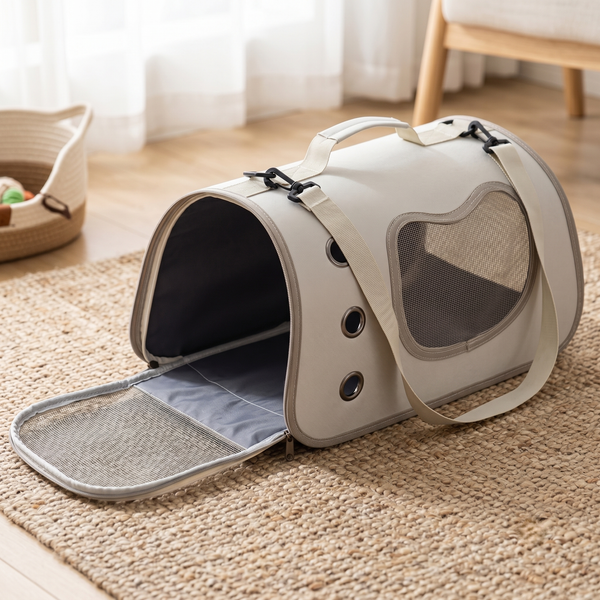
The carrier's construction uses three functional layers. The transparent bubble dome provides panoramic observation. The Oxford cloth back panel creates a solid, secure rear wall that blocks overstimulation from behind. And nine metal-rimmed ventilation holes plus a full-length zippered mesh panel ensure constant fresh airflow from every angle — preventing heat buildup even during summer journeys.
Security features include an internal leash clip that attaches to your cat's harness, preventing any possibility of escape when the top is opened. The double-zipper closure means zips can be positioned to prevent paw manipulation from inside — a common escape method with single-zip carriers. The padded dual shoulder straps with chest buckle distribute your cat's weight evenly across your back rather than pulling on one shoulder.
UK pet owners encounter four main carrier types. Each has advantages depending on your travel frequency and your cat's temperament:
| Feature | Backpack Carrier | Plastic Crate | Soft-Sided Bag | Wheeled Trolley |
|---|---|---|---|---|
| Visibility for cat | ✅ 270° panoramic | ❌ Dark interior | ⚠️ Mesh panels only | ⚠️ Limited mesh |
| Ventilation | ✅ 9 holes + mesh panel | ⚠️ Small slits | ✅ Full mesh sides | ✅ Mesh panels |
| Hands-free | ✅ Both hands free | ❌ One hand occupied | ⚠️ Shoulder strap | ✅ Pull handle |
| Weight on owner | ✅ Distributed on back | ❌ One-sided strain | ❌ One shoulder | ✅ No lifting |
| Car travel safe | ✅ Seatbelt loop | ✅ Stable base | ⚠️ Can collapse | ⚠️ May roll |
| Cat stress level | ✅ Low (visibility) | ❌ High (dark, isolated) | ⚠️ Medium | ⚠️ Medium |
| Max weight capacity | 6–7 kg | 8–10 kg | 5–6 kg | 8–12 kg |
Pro Tip: The bubble dome is removable — on very hot days or for cats that prefer more airflow, replace it with the included mesh cover for maximum ventilation while maintaining full security.
5 Benefits of a Transparent Backpack Carrier
1. Dramatically Reduced Travel Anxiety
The single biggest change between a dark crate and a bubble backpack is stress reduction. Cats that can see outside — particularly their owner's back and head — remain calmer because they maintain environmental awareness. Instead of being trapped in the unknown, they are observing from a secure vantage point. Many owners report their cat voluntarily entering the backpack within weeks of introduction. If your cat also struggles with general anxiety at home, a CozyPaws™ Calming Donut Bed provides the same secure-observation principle in bed form.
2. Hands-Free Convenience
Traditional carriers occupy one hand completely — making it impossible to open doors, hold keys, manage another pet, or check your phone for directions. A backpack carrier frees both hands entirely. The chest strap prevents swinging, and the padded straps mean you can carry a 6 kg cat for extended periods without shoulder strain.
3. Even Weight Distribution
Carrying a plastic crate with one arm puts significant asymmetric strain on your shoulder, back, and wrist — especially problematic for longer walks to the vet. A backpack distributes weight evenly across both shoulders and your core. The difference is particularly noticeable with heavier cats (5 kg+).
4. Versatility Beyond Vet Visits
A backpack carrier is not just for vet trips. It opens up outdoor adventures — supervised garden time, café visits, park walks — that most indoor cats never experience. This environmental enrichment benefits mental health significantly for indoor cats who otherwise have limited stimulation variety. Pair outdoor backpack time with a CozyPaws™ Cat Tree at home for a complete enrichment strategy — our cat tree guide explains how to choose the right height and configuration for your space.
5. Year-Round Usability
Unlike carriers that overheat in summer or provide no insulation in winter, the ventilation system on the CozyPaws™ Cat Backpack adapts to both seasons: dome on for cold weather warmth and visibility, dome off with mesh cover for maximum summer airflow. For winter journeys, line the base with a CozyPaws™ Self-Warming Pet Pad to keep your cat cosy during cold walks.
Shop the CozyPaws™ Cat Backpack →
Before You Start
- Weigh your cat — confirm they are under 7 kg. Cats consistently over 6.5 kg may need a rigid carrier with higher capacity.
- Get a well-fitting harness — the internal leash clip requires a harness, not a collar. Measure your cat's chest and test the fit before carrier training begins.
- Choose a calm room — the introduction space should be your cat's favourite, most relaxed room with minimal noise and foot traffic.
- Gather high-value treats — standard biscuits will not cut it. Use your cat's absolute favourite rewards — cooked chicken, Dreamies, or whatever motivates them most. A CozyPaws™ Lick Mat loaded with wet food also works brilliantly for building positive association.
- Allow 7–14 days minimum — rushing the introduction is the single most common mistake. Anxious cats may need 3–4 weeks.
- Check your cat's health — avoid starting carrier training if your cat is unwell, recovering from surgery, or currently under veterinary treatment for stress.
How to Introduce Your Cat to a Carrier — Step by Step
The biggest mistake owners make is only bringing the carrier out on travel day. This guarantees a stress association. Instead, follow this gradual introduction process over 7–14 days:
Step 1: Make the Carrier Part of Home (Days 1–3)
Place the backpack open on the floor in your cat's favourite room. Remove the bubble dome so it feels more like a bed than an enclosure. Place a familiar blanket or worn t-shirt inside. Do not interact — let your cat investigate at their own pace. Most cats will sniff and enter within 24–48 hours.
Step 2: Build Positive Association (Days 3–7)
Begin placing treats and favourite toys inside the carrier daily. Feed one meal per day beside the carrier, then gradually move the bowl inside it. The goal is simple: carrier equals good things happen. Never close the carrier during this phase — trust must be built before confinement.
Step 3: Short Enclosure (Days 7–10)
Once your cat voluntarily enters and rests inside, attach the bubble dome for 5 minutes while feeding treats through the ventilation holes. Increase to 15 minutes over several sessions. If your cat shows any stress — flattened ears, excessive vocalisation, escape attempts — open immediately and return to Step 2. Patience here prevents weeks of setback.
Step 4: Indoor Wearing (Days 10–12)
With your cat secure inside, lift the backpack and wear it around the house for 2–3 minutes. Walk slowly, talk calmly, and set down and reward immediately upon release. Increase duration gradually to 10–15 minutes over several sessions.
Step 5: First Outdoor Trip (Days 12–14)
Take a short 5-minute walk — around the garden or to the end of the street and back. Avoid noisy roads for the first trip. Reward heavily upon return. Most cats that have completed Steps 1–4 calmly will accept outdoor trips readily from this point.
| Journey Type | Duration | Frequency | Key Tip |
|---|---|---|---|
| Vet visit | 15–45 minutes | 2–4× per year | Keep carrier visible at home between visits |
| Garden exploration | 15–30 minutes | Daily if desired | Start in an enclosed garden only |
| Neighbourhood walk | 30–60 minutes | 2–3× per week | Avoid busy roads until confident |
| Car journey | Up to 2 hours | As needed | Seatbelt through back loop, rear seat only |
| Extended travel | 2–4 hours maximum | Rarely | 30-minute breaks with water every 2 hours |
Quick Check — Is Your Cat Carrier-Ready?
- ✅ Cat enters backpack voluntarily without coaxing
- ✅ Stays calm with dome attached for 15+ minutes
- ✅ Comfortable being carried indoors for 10+ minutes
- ✅ First short outdoor trip completed without panic
- ✅ Accepts treats and remains relaxed throughout the journey
Safety, Car Travel & When to See a Vet
A carrier is only useful if it is completely secure. The Cats Protection recommends that any carrier allows the cat to stand, turn around, and lie down comfortably. The CozyPaws™ backpack dimensions (35 × 25 × 42 cm) accommodate this for cats up to 7 kg — always verify your cat's stretched length before purchasing.
- ✅ Internal leash clip — attaches to harness, prevents escape when opened
- ✅ Double-zipper closure — zips meet in centre, prevents paw manipulation
- ✅ Metal-rimmed ventilation holes — will not crack or collapse over time
- ✅ Reinforced base — maintains structural shape, will not sag under weight
- ✅ Chest strap — prevents backpack swinging during movement
- ✅ Non-toxic materials — PVC dome and Oxford cloth, safe if licked or chewed
UK Car Travel Rules
Under the UK Highway Code (Rule 57), animals must be suitably restrained during car travel so they cannot distract the driver or be injured in an emergency stop. A loose cat in a car is both illegal and dangerous. Thread the seatbelt through the back loop to secure the backpack to the seat. Place the carrier on the rear seat with the bubble facing the side window so your cat can watch the scenery — never on the front seat where airbag deployment could be fatal.
Pro Tip: Cats prone to car sickness benefit from the backpack's visibility — motion sickness is worsened by inability to see the horizon. Position the carrier so your cat can see out of the car window, and avoid feeding 2–3 hours before travel.
⚠️ Warning: Never leave your cat unattended in any carrier in a parked vehicle. Interior car temperatures reach 47 °C within 20 minutes even on a mild 22 °C day. If you must stop, take the backpack with you — that is the entire point of a wearable carrier. For summer travel safety, read our complete guide to keeping pets cool.
⚠️ When to See a Vet
- Open-mouth panting that does not resolve within 5 minutes of exiting the carrier
- Loss of bladder or bowel control during travel — may indicate an extreme stress disorder
- Refusal to eat or drink for more than 12 hours after a journey
- Aggression or prolonged hiding lasting more than 24 hours post-travel
- Vomiting during every journey despite withholding food beforehand
- Signs of heat stress: glazed eyes, excessive drooling, staggering, or collapse
If your next carrier journey is a vet appointment and you want to reduce stress at every stage — from carrier training and safe transport to managing the waiting room, understanding what happens during the examination, and settling your cat back home afterwards — our complete guide to taking your cat to the vet in the UK covers the entire process step by step, including an age-based check-up schedule, a preparation checklist, and a full UK vet cost breakdown.
Cats Protection recommends consulting a veterinary behaviourist if your cat's travel anxiety does not improve after four weeks of gradual carrier training — persistent phobia may require professional intervention alongside pheromone therapy.
Carrier Comparison & 5-Year Value
| Cost Factor | Plastic Crate | Premium Soft Carrier | CozyPaws™ Backpack |
|---|---|---|---|
| Purchase price | £15–£30 | £35–£60 | £44.99 |
| Lifespan | 3–5 years (cracks) | 1–2 years (tears) | 5+ years (rigid + washable) |
| Replacement cost (5 yrs) | £15–£30 (1 replacement) | £70–£180 (2–3 replacements) | £0 |
| Total 5-year cost | £30–£60 | £105–£240 | £44.99 |
| Stress reduction | ❌ None | ⚠️ Moderate | ✅ Significant |
| Vet visit compliance | ⚠️ Often delayed | ⚠️ Sometimes delayed | ✅ Regular attendance |
| Versatility | Vet only | Vet + short trips | Vet + walks + adventures |
5-Year ROI: A single missed vet visit due to carrier stress can result in undetected health issues costing £200–£500+ in emergency treatment. A carrier that your cat accepts willingly — enabling regular preventive care — pays for itself with the first avoided emergency. Over five years, the CozyPaws™ backpack costs less than a single replacement cycle of cheap soft carriers while delivering dramatically better outcomes for your cat's health and wellbeing.
Frequently Asked Questions
Will my cat actually accept a backpack carrier?
Yes — with proper introduction. Cats introduced gradually over 7–14 days accept backpack carriers readily because the transparent dome satisfies their instinct to observe their surroundings. Cats Protection recommends leaving any new carrier out as furniture for at least a week before attempting travel. Many cats begin entering voluntarily within two weeks, and some actively request to go in when they see the backpack come out.
Is 6–7 kg enough for my cat?
The 6–7 kg capacity covers the vast majority of UK cat breeds including British Shorthairs, Bengals, Ragdolls (females), and all standard domestic cats. Only very large males — Maine Coons over 8 kg or large male British Shorthairs — may exceed this limit. Weigh your cat before purchasing; if they are consistently over 6.5 kg, a rigid crate with higher capacity may be more appropriate.
Can I use this for a small dog?
Yes — the carrier suits small dogs up to 6–7 kg including Chihuahuas, Pomeranians, Toy Poodles, Yorkshire Terriers, and Miniature Dachshunds. The internal leash clip attaches to any standard harness. Ensure your dog can sit comfortably without their head pressing against the dome. For calming nervous small dogs before travel, try spreading a thin layer of peanut butter on a CozyPaws™ Lick Mat — the repetitive licking action reduces anxiety naturally.
How do I clean the bubble dome?
Rinse the dome under warm water and wipe with a soft cloth. For scratches that reduce clarity, a small amount of plastic polish restores transparency. Clean the dome weekly during regular use — cat nose prints and condensation build up quickly and reduce your cat's visibility, which partially defeats the purpose of the panoramic design. The removable base pad is machine washable at 30 °C.
Is the carrier airline approved?
The dimensions (35 × 25 × 42 cm) fit within most airline under-seat requirements, but always confirm with your specific airline before booking. Some airlines require soft-sided carriers only. For UK domestic flights and Eurostar, the carrier meets size requirements for most pet-friendly services — check individual operator policies at least two weeks before travel.
What if my cat panics inside?
If your cat shows acute stress — aggressive escape attempts, open-mouth panting, loss of bladder control — open the carrier immediately in a secure enclosed space. This typically indicates the introduction process was rushed. Return to Step 2 of the training process above and proceed more gradually. The Cats Protection recommends consulting a qualified behaviourist if panic responses persist after three separate gradual introduction attempts.
Can my cat overheat in the backpack during summer?
The nine ventilation holes plus full-length mesh panel provide continuous airflow. For temperatures above 25 °C, remove the bubble dome and use the mesh cover option for maximum ventilation. Avoid direct sun exposure to the dome — clear PVC can create a greenhouse effect in intense sunlight. Walk in shade, monitor for panting, and carry water. For more warm-weather advice, see our complete guide to pet cooling mats.
How long can my cat stay in the carrier?
For active carrying — walking or travelling — limit sessions to 2–3 hours with breaks for water and stretching. For stationary use with the dome open — resting at a café or a friend's house — your cat can stay as long as they are comfortable. Cats Protection advises never confining a cat in any carrier for more than 4 hours without a full break in a secure open space.
Does the carrier work for nervous or anxious cats?
Anxious cats often benefit most from visible carriers because their stress is driven by fear of the unknown. However, severely anxious cats need a longer introduction period — 3–4 weeks instead of two. Combine carrier training with Feliway pheromone spray inside the carrier 15 minutes before use for maximum calming effect. At home, a CozyPaws™ Calming Donut Bed gives anxious cats a permanent safe space — read our complete guide to calming beds for anxious pets for the full approach.
For a deeper understanding of why some cats develop severe carrier phobia — including the difference between motion sickness and genuine travel anxiety, and a 12-breed risk table — see our in-depth guide to why cats hate the carrier.
Can two cats share one carrier?
No — never place two cats in a single carrier regardless of size. Cats that are bonded at home may still become aggressive when confined together in a stressful travel situation. Each cat requires their own carrier with their own space. For multi-cat households, the CozyPaws™ Cat Backpack is lightweight enough to carry one cat on your back while a second travels in a standard carrier by hand.
Ready to Make Cat Travel Stress-Free?
- ❌ Wrestling your cat into a dark plastic crate
- ❌ One-handed carrying that strains your shoulder
- ❌ Constant yowling and scratching during every journey
- ❌ Skipping vet visits because the carrier stress is not worth it
- ✅ A cat that voluntarily enters their carrier
- ✅ Calm, quiet journeys with full panoramic visibility
- ✅ Hands-free convenience with even weight distribution
- ✅ Outdoor adventures your indoor cat has never experienced
Shop the CozyPaws™ Cat Backpack →
Questions about the CozyPaws™ Bubble Window Cat Backpack? Email us at support@thecozypaws.co.uk — we're here to help.