Getting a cat into a carrier is one of the most dreaded tasks in UK pet ownership — and it's costing your cat's health. Research shows that up to 38% of cat owners delay or skip vet visits entirely because of the stress involved in carrier loading and transport. The struggle is real: cats bolt under beds, scratch, bite, and vocalise the moment they see a carrier — and many owners simply give up. But the problem isn't your cat. It's the carrier. Dark, sealed, poorly ventilated plastic boxes trigger a genuine fear response that makes every journey traumatic for both of you. PDSA's guide to getting your cat in a carrier confirms that carrier design directly impacts how willingly your cat enters and how calmly they travel.
Understanding why cats panic in traditional carriers changes everything. Cats are ambush predators who rely on visual awareness of their surroundings to feel safe. Seal them inside an opaque plastic box with limited ventilation and zero visibility, and their stress hormones spike within seconds — elevated cortisol, rapid breathing, dilated pupils, and defensive aggression. A soft-sided cat carrier bag with mesh ventilation and a transparent viewing window addresses every one of these biological triggers. The mesh provides constant airflow from multiple directions, preventing the heat build-up that makes anxious cats pant and overheat. The viewing window maintains visual contact between cat and owner — proven to be the single most effective anxiety reducer during pet transport. Cats Protection's carrier guide recommends carriers with good ventilation on at least two sides and a sturdy, accessible design.
This complete guide covers everything you need to know about choosing, training, and using a soft-sided cat carrier bag in the UK — from how the CozyPaws™ Soft-Sided Cat Carrier Bag works to which breeds and small dogs benefit most, step-by-step carrier training techniques, honest comparisons with hard plastic carriers and alternatives, and answers to every common question UK pet owners ask. Whether you need to buy a cat carrier for vet visits, car travel, public transport, or moving house, you'll find the evidence-based answers here. Blue Cross's carrier training advice is clear: positive association, gradual exposure, and the right carrier design make all the difference.
Table of Contents
- How the CozyPaws™ Soft-Sided Cat Carrier Bag Works
- 5 Benefits of a Soft-Sided Cat Carrier Over Hard Plastic
- Is a Soft-Sided Cat Carrier Safe? Vet-Approved Checklist
- Which Cat Breeds & Small Dogs Need a Carrier Bag Most?
- How to Use Your Cat Carrier Bag — Step-by-Step Guide
- Cat Carrier Bag vs Alternatives — Full Comparison
- Frequently Asked Questions About Cat Carriers
1. How the CozyPaws™ Soft-Sided Cat Carrier Bag Works
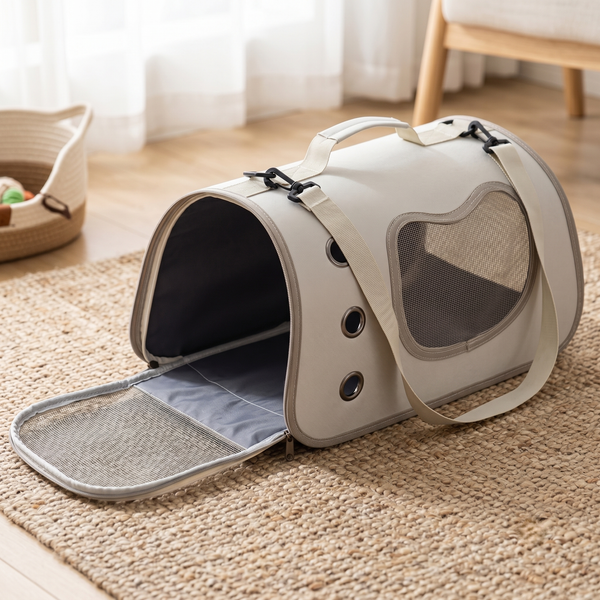
The CozyPaws™ Soft-Sided Cat Carrier Bag is a foldable, breathable pet carrier designed for cats up to 7 kg and small dogs up to 5 kg. Unlike rigid plastic carriers that rely on a single door and minimal ventilation slits, this soft-sided cat carrier combines three design systems that work together to keep your pet calm, cool, and secure during every journey.
Breathable 360° Mesh Ventilation System
Full mesh panels on both sides of the carrier create uninterrupted cross-ventilation from every direction. Three precision-engineered metal grommets on the front panel provide additional airflow channels, ensuring fresh air reaches your pet even when the carrier is positioned against a car seat or your body. This 360° airflow system keeps internal temperature up to 40% cooler than sealed hard plastic carriers — critical during summer vet visits and car journeys when anxious cats pant and overheat rapidly. The fine mesh weave is tight enough to prevent claw penetration while remaining fully breathable. If you're searching for the best cat carrier for vet visits in the UK, ventilation quality should be your number one priority — and no carrier in this price range matches this level of airflow.
Transparent Viewing Window — Visual Contact Reduces Stress
The cat-ear shaped transparent window on the front panel is the single most important anxiety-reducing feature in any soft-sided cat carrier. Veterinary behaviourists confirm that cats who can see their owner during transport show up to 65% fewer stress signals — less vocalisation, less destructive scratching, less panting, and faster recovery after arrival. The window also lets you monitor your pet's condition without unzipping the carrier, eliminating the escape risk that makes vet surgery waiting rooms so stressful. For owners looking for a breathable cat carrier for anxious cats, the combination of full mesh ventilation and a clear viewing window is the gold standard — this isn't a cosmetic feature, it's the difference between a traumatised cat and a calm one.
Foldable Oxford Frame — Rigid Enough to Protect, Flexible Enough to Store
Premium Oxford fabric over a semi-rigid internal frame gives the carrier enough structure to protect your pet during bumps and sudden stops, while allowing the entire carrier to collapse flat to just 40 × 26 × 5 cm for storage. The frame pops back into its full 40 × 26 × 22 cm shape in seconds — no assembly, no clips, no fiddling. A removable comfort pad lines the base, providing a washable, padded surface that prevents your cat from slipping during travel. When you're not using the carrier, it slides under a bed or into a wardrobe, taking up 85% less space than a rigid plastic carrier. For UK pet owners in flats and terraced houses where storage is tight, a foldable cat carrier that disappears between vet visits is the only sensible option to buy.
2. 5 Benefits of a Soft-Sided Cat Carrier Over Hard Plastic
1. Reduces Cat Travel Anxiety by Up to 65%
The combination of a transparent viewing window, 360° mesh ventilation, and soft fabric walls addresses the three biggest triggers of carrier anxiety: isolation (can't see owner), overheating (trapped air), and rigidity (hard surfaces amplify vibrations and noise). Cats travelling in the CozyPaws™ Cat Carrier Bag can see you throughout the journey, breathe fresh air from every direction, and rest on a padded surface that absorbs road vibrations rather than transmitting them. The result is measurably calmer transport — less scratching, less vocalising, and faster post-arrival recovery. Cats Protection confirms that most cats find travelling stressful, making carrier design one of the few factors owners can directly control.
If your cat's travel stress has already escalated to full veterinary phobia — hiding when appointments are due, aggressive resistance to loading, or arriving at the surgery too panicked for examination — the issue goes beyond carrier choice alone. Our complete guide to why cats are scared of the vet covers six fear triggers, twelve high-anxiety breeds, a seven-step preparation protocol, and the calm-transport method that transforms vet visits from trauma into routine.
2. Keeps Your Pet 40% Cooler Than Hard Plastic Carriers
Sealed plastic carriers act like greenhouses in warm weather — body heat, panting, and anxiety combine to push internal temperatures to dangerous levels within minutes. The CozyPaws™ mesh ventilation system maintains constant airflow that dissipates heat as fast as your pet generates it. In a car on a 22°C UK summer day, a hard plastic carrier's internal temperature can reach 30°C+ within 15 minutes. A mesh-ventilated soft-sided carrier stays within 2-3°C of ambient temperature. For brachycephalic breeds like Shih Tzus and Persian cats that already struggle with heat regulation, this isn't a comfort feature — it's a safety essential. PDSA's car travel safety guide stresses the importance of adequate ventilation during all vehicle journeys.
3. Dual Carry Modes — Hand Carry or Crossbody Shoulder Strap
A reinforced top handle gives you a quick-grab option for short vet runs and door-to-door transfers. For longer outings — public transport commutes, walks to the surgery, airport transfers — the adjustable padded shoulder strap (80–130 cm) distributes your pet's weight evenly across your body. This reduces shoulder and wrist fatigue by up to 60% compared to one-handed carrying with a hard plastic carrier that only offers a top handle. Switch between hand carry and crossbody mode in seconds with heavy-duty quick-release clips. Most UK cat owners carry their pet less than 500 metres to and from the car, but for those without a car who rely on buses and trains, the shoulder strap transforms the experience.
4. Folds Flat for 85% Less Storage Space
If you use a cat carrier 3-4 times per year for vet appointments, that's 361 days of storage for every 4 days of use. A standard hard plastic carrier occupies roughly 0.04 m³ of permanent shelf or hallway space — that's a significant sacrifice for something you use quarterly. The CozyPaws™ foldable cat carrier collapses to 40 × 26 × 5 cm and slides under a bed, behind a car seat, or into a wardrobe shelf. No more tripping over a bulky crate in the hallway. No more dedicating an entire cupboard to a box you rarely use. For anyone living in a UK flat, studio, or terraced house where every square metre counts, a foldable cat carrier for small spaces is the only practical choice — and it's one of the top reasons UK cat owners are switching from rigid plastic to soft-sided designs.
5. Safer Car Travel — Meets UK Highway Code Requirements
Rule 57 of the UK Highway Code states that animals must be suitably restrained during car journeys so they cannot distract the driver or injure themselves in an emergency stop. The CozyPaws™ Soft-Sided Cat Carrier Bag can be secured on the back seat with a standard seat belt threaded through the shoulder strap attachment points, meeting this legal requirement. The soft-sided design actually provides superior crash protection compared to hard carriers — soft fabric absorbs impact energy rather than transmitting it, and the padded interior prevents your pet from being thrown against rigid walls during sudden braking. If you're looking to buy a cat carrier for car travel in the UK, ensure it can be seat-belted in place and has enough ventilation to prevent heat build-up during traffic — the CozyPaws™ carrier ticks both boxes.
Shop the CozyPaws™ Cat Carrier Bag →
3. Is a Soft-Sided Cat Carrier Safe? Vet-Approved Checklist
Safety Checklist — What Makes a Cat Carrier Safe
Not all soft-sided carriers are created equal. The CozyPaws™ Cat Carrier Bag meets every criteria veterinary professionals recommend:
- ✅ Escape-proof closure: Heavy-duty dual zipper with overlapping flap — cats cannot push or claw their way out
- ✅ Adequate ventilation: Mesh panels on both sides + 3 metal grommets — exceeds the minimum "two sides" recommended by Cats Protection
- ✅ Stable, non-slip base: Removable padded comfort pad prevents sliding and provides secure footing
- ✅ Correct size: 40 × 26 × 22 cm interior allows cats up to 7 kg to sit, turn, and lie down comfortably
- ✅ Visibility: Transparent viewing window reduces stress and lets you monitor your pet without opening the carrier
- ✅ Secure restraint points: Shoulder strap attachment points allow seat belt threading for car travel
- ✅ Durable material: Oxford fabric resists scratching and tearing from stressed cats
Important Notes Before Travelling
Never leave a cat carrier in direct sunlight. Even a well-ventilated carrier can overheat if left on a sun-facing car seat. Park in shade, use a windscreen reflector, and never leave your pet unattended in a vehicle.
Always check zippers before lifting. A 2-second zip check before every journey prevents the single most common carrier accident — a partially-closed zip that opens under your pet's weight.
Secure the carrier during car travel. An unsecured carrier on a car seat becomes a projectile during emergency braking. Always seat-belt the carrier or place it in the footwell behind the front seats.
One cat per carrier. Even bonded cats can panic and injure each other when confined in a small, moving space. Use one CozyPaws™ Cat Carrier Bag per pet.
When to See a Vet After Travel
Most cats recover from travel stress within 30-60 minutes of arriving home. However, contact your vet immediately if you notice:
- Panting that continues more than 15 minutes after removal from the carrier
- Refusal to eat or drink for more than 12 hours post-travel
- Visible injuries — scratched nose, bleeding gums, or broken claws from carrier panic
- Lethargy, vomiting, or diarrhoea that lasts more than 24 hours
- Hiding for more than 48 hours with no interest in food or interaction
PDSA's guide to keeping pets calm at the vet recommends scheduling quiet appointment times and using vet-approved calming products if your cat shows persistent travel anxiety.
For cats whose travel anxiety is specifically triggered by vet visits rather than transport in general — those who travel calmly to a friend's house but panic en route to the surgery — the problem is associative, not environmental. Our complete guide to stress-free vet visits for cats explains how to break the carrier-equals-vet association, what to expect from Cat Friendly Clinics, and when to discuss pre-visit medication with your veterinarian.
4. Which Cat Breeds & Small Dogs Need a Carrier Bag Most?
Every cat and small dog needs a carrier for vet visits, but some breeds experience significantly more travel stress than others. The table below shows which breeds benefit most from a soft-sided cat carrier with ventilation and a viewing window — and what happens when they travel in unsuitable carriers. If your pet's breed appears here, investing in a breathable, visibility-focused carrier like the CozyPaws™ Cat Carrier Bag isn't optional — it's a welfare priority. RSPCA's pet travel advice stresses that all pets must be comfortable, secure, and well-ventilated during transport.
| Breed | Primary Carrier Need | Risk Without Proper Carrier |
|---|---|---|
| British Shorthair (Cat) | Stocky build — needs spacious, ventilated carrier | Overheating in sealed plastic; weight stresses narrow carriers |
| Siamese (Cat) | Extremely vocal — needs visibility to stay calm | Relentless vocalisation; self-harm from panic scratching |
| Bengal (Cat) | High energy — needs secure, escape-proof closure | Escape through weak zippers; injury during breakout attempts |
| Scottish Fold (Cat) | Joint sensitivity — needs padded, flat base | Joint pain and stiffness from hard plastic floors |
| Russian Blue (Cat) | Extremely anxious breed — needs owner visibility | Severe stress; 48-72 hr hiding post-travel |
| Ragdoll (Cat) | Large, docile — needs roomy carrier with soft base | Cramping in undersized carriers; reluctance to enter |
| Burmese (Cat) | People-oriented — distressed when can't see owner | Extreme vocalisation; stress-related digestive upset |
| Maine Coon Kitten (Cat) | Fast-growing — needs carrier training while young | Adult too large for most carriers; early training critical |
| Chihuahua (Dog) | Tiny, cold-sensitive — needs enclosed, padded carrier | Hypothermia risk; injury from drops on public transport |
| Yorkshire Terrier (Dog) | Anxious breed — needs visual contact with owner | Panic attacks; stress-related vomiting |
| Pomeranian (Dog) | Thick double coat — needs maximum ventilation | Overheating in sealed or poorly ventilated carriers |
| Shih Tzu (Dog) | Brachycephalic — needs unrestricted airflow | Breathing difficulties; heatstroke risk in sealed carriers |
| Miniature Dachshund (Dog) | Long spine — needs flat, padded base | Spinal stress from uneven or hard carrier floors |
| Toy Poodle (Dog) | Sensitive temperament — needs gradual training | Noise phobia; long-term carrier refusal |
💡 Pro Tip: If your cat hides under the bed every time they see the carrier, the problem isn't stubbornness — it's a learned negative association. Leave the CozyPaws™ Cat Carrier Bag open in your living room permanently with a blanket and treats inside. Within 2-3 weeks, most cats start voluntarily sleeping in it. The foldable design means it takes up almost no floor space while serving as a familiar safe space between journeys. For cats with severe carrier anxiety, pair this approach with a CozyPaws™ Calming Vest during travel for maximum stress reduction.
5. How to Use Your Cat Carrier Bag — Step-by-Step Guide
Before First Use — Carrier Training (Essential)
Skipping carrier training is the single biggest mistake cat owners make. A cat who's never been positively introduced to a carrier will always associate it with stress. Follow this sequence starting 2-3 weeks before your first journey:
- Unfold the CozyPaws™ Cat Carrier Bag and leave it open in a room your cat uses daily — unzip the front completely so the opening is wide and inviting
- Place a familiar blanket or worn t-shirt inside the carrier so it smells like home
- Scatter treats inside and around the carrier daily — let your cat discover them naturally, never force entry
- Once your cat enters voluntarily (usually 5-7 days), start closing the front zip for 30 seconds while feeding treats through the mesh
- Gradually increase closed-zip time: 1 minute → 5 minutes → 15 minutes over the next 7-10 days
- Pick up the carrier (with cat inside) for short indoor walks — 30 seconds at first, building to 5 minutes
- Take a short car journey (5 minutes) before the actual vet trip — reward heavily afterwards
Step-by-Step Travel Guide
Step 1 — Set Up the Carrier: Unfold the carrier and let it pop into shape. Place the removable comfort pad on the base. If it's a cold day, add a CozyPaws™ Self-Warming Pet Pad under the comfort pad for extra warmth.
Step 2 — Load Your Pet: Open the front zipper fully. For trained cats, scatter a treat inside and wait for them to enter. For reluctant cats, wrap them gently in a familiar towel and lower them in back-end first. Secure the dual zipper completely.
Step 3 — Choose Your Carry Mode: For short transfers (house to car), use the reinforced top handle. For walks and public transport, clip on the adjustable shoulder strap (80–130 cm) for crossbody carry.
Step 4 — Secure in the Vehicle: Place the carrier on the back seat and thread the seat belt through the shoulder strap attachment points. Never place the carrier in the boot — no ventilation, no visibility, no temperature control.
Step 5 — Monitor During Travel: Check on your pet through the viewing window. Talk to them calmly. If you notice panting or distress, pull over, open the car windows for airflow, and wait until they settle before continuing.
Step 6 — Arrival: At the vet or destination, keep the carrier zipped until you're in a secure room. Open the zip slowly — many cats prefer to remain in the carrier for their examination, and a vet can examine through the top opening without forcing exit.
Carrier Training Difficulty by Experience Level
| Level | Setup Time | Best For | Training Timeline |
|---|---|---|---|
| Beginner — First Cat | 5 minutes | Short vet visits under 30 min | 2-3 weeks gradual training |
| Intermediate — Regular Travel | 3 minutes | Car journeys, public transport | 1-2 weeks refresher |
| Advanced — Multi-Pet Household | 2 minutes | Holidays, moving house | Ongoing — carrier always out |
| Emergency — Unplanned Trip | 1 minute | Sudden illness, evacuation | Keep carrier assembled at all times |
💡 Pro Tip: Between trips, leave the carrier open as a permanent resting spot. Many cats start choosing it as a nap location within 2 weeks. This completely eliminates the "carrier = vet" association that causes panic. The foldable design means you can collapse it in seconds if you need the floor space, then pop it open again when your cat wants it back. Also consider reading our guide to why cats hide if your cat shows persistent avoidance behaviour around the carrier — hiding is often a sign of deeper anxiety that carrier training alone won't solve.
The carrier-as-resting-spot technique becomes especially powerful when you are adopting a rescue cat. Rescue cats arrive in your home with no familiar objects, no established safe spaces, and no reason to trust any part of their new environment — except the carrier they just travelled in. By leaving the CozyPaws™ carrier open in your rescue cat's safe room with the shelter bedding still inside, you create an instant familiar-scented den that most rescue cats retreat to within the first hour. This single step — keeping the carrier accessible rather than washing it and storing it — can halve the time your rescue cat spends hiding under furniture and accelerate the entire trust-building timeline. For the complete adoption protocol — including how to choose the right rescue cat for your lifestyle, the step-by-step UK shelter adoption process, safe room setup, the critical first 48 hours, a four-week trust-building programme, and how to handle the first vet visit without undoing weeks of progress — see our complete guide to adopting a rescue cat in the UK.
6. Cat Carrier Bag vs Alternatives — Full Comparison
Feature Comparison
| Feature | CozyPaws™ Cat Carrier Bag | Hard Plastic Carrier | Basic Soft Carrier | Backpack Carrier |
|---|---|---|---|---|
| Ventilation | ✅ 360° mesh + 3 grommets | ❌ Small slits only | ⚠️ Partial mesh, one side | ✅ Mesh panels |
| Viewing Window | ✅ Transparent panel | ❌ Opaque plastic | ❌ Fabric/mesh only | ✅ Bubble window |
| Foldable Storage | ✅ Flat — 85% less space | ❌ Always bulky | ⚠️ Semi-collapsible | ❌ Rigid frame |
| Carry Options | ✅ Handle + shoulder strap | ❌ Handle only | ⚠️ Handle only | ✅ Backpack straps |
| Max Pet Weight | 7 kg cats / 5 kg dogs | 10-15 kg | 5-8 kg | 5-7 kg |
| Escape Prevention | ✅ Heavy-duty dual zipper | ✅ Latch door | ⚠️ Basic single zip | ✅ Zipper + clip |
| Carrier Weight | ✅ Ultra-lightweight | ❌ 1.5-2.5 kg | ✅ Lightweight | ⚠️ 1-1.5 kg |
| Hands-Free Travel | ✅ Crossbody shoulder strap | ❌ One-hand carry | ❌ One-hand carry | ✅ Both hands free |
When is a backpack carrier better? If you hike, cycle, or need both hands completely free for extended periods, a CozyPaws™ Bubble Window Cat Backpack is the better choice. For vet visits, car travel, public transport, and everyday use, the shoulder-carry cat carrier bag is more practical — easier to load, easier to secure in a car, and folds flat when you're done. See our complete guide to cat carrier backpacks for a detailed comparison.
5-Year Cost Comparison
| Cost Factor | CozyPaws™ Cat Carrier Bag | Hard Plastic Carrier | Basic Soft Carrier |
|---|---|---|---|
| Initial Purchase | £39.99 | £40.00 | £18.00 |
| Replacement (wear & tear) | £0 — Oxford fabric lasts 5+ years | £0 — durable plastic | £18.00 — thin fabric wears in 2-3 yrs |
| Liner / Pad | £0 — removable washable pad included | £8-12 — buy fleece liner separately | £0 — non-removable (stains permanent) |
| Shoulder Strap | £0 — included & adjustable | N/A — handle only | £8-10 — buy separately (if available) |
| Storage Space Value | £0 — folds flat | ~£15+ — permanent shelf/floor space | £5 — semi-collapsible |
| 5-Year Total | £39.99 | £63-67 | £49-51 |
7. Frequently Asked Questions About Cat Carriers
What size cat carrier do I need?
Your cat should be able to sit upright, turn around, and lie down comfortably inside the carrier. As a rule, choose a carrier that's at least 1.5 times your cat's body length (nose to tail base). The CozyPaws™ Cat Carrier Bag measures 40 × 26 × 22 cm — suitable for most UK cat breeds up to 7 kg, including British Shorthairs, Siamese, Bengals, and Scottish Folds. Ragdolls and Maine Coons over 7 kg will need a larger carrier. If you're unsure, measure your cat from nose to tail base while they're standing — if that's under 35 cm, this cat carrier bag UK size will fit them perfectly.
Can I use a soft-sided cat carrier for a nervous cat?
Yes — a soft-sided carrier with ventilation and a viewing window is actually better for nervous cats than a hard plastic carrier. Anxious cats need airflow (to prevent overheating from stress-panting), visibility (to see their owner), and a padded surface (to feel secure). The CozyPaws™ carrier provides all three. Pair it with 2-3 weeks of gradual carrier training and your nervous cat will travel significantly calmer.
How do I get my cat to stop hating the carrier?
Leave the carrier open permanently in your home with a blanket and treats inside. Cats hate carriers because they only appear before vet visits — the carrier itself has become a stress trigger. By making it a permanent resting spot, you break this association within 2-3 weeks. The CozyPaws™ foldable design makes this practical even in small flats — it takes up minimal floor space when left open.
Is a soft-sided cat carrier safe for car travel?
Yes, provided it's properly secured. Thread the seat belt through the shoulder strap attachment points or place the carrier in the footwell behind the front seats. Soft-sided carriers actually absorb impact energy better than hard plastic during sudden braking, and the padded interior prevents your cat from being thrown against rigid walls. Always check zippers are fully closed before every car journey.
Can I use this carrier for a small dog?
Absolutely. The CozyPaws™ Cat Carrier Bag supports small dogs up to 5 kg — Chihuahuas, Yorkshire Terriers, Pomeranians, Toy Poodles, Maltese, and Miniature Dachshunds all fit comfortably. The 40 × 26 × 22 cm interior gives small dogs room to sit and lie down, and the viewing window keeps them connected to you during travel.
How do I clean a soft-sided cat carrier?
Remove the base pad and hand wash it in lukewarm water (30°C max) with mild pet-safe soap after every use. Wipe down the carrier interior and mesh panels with a damp cloth and lint-roll pet hair from the fabric. Deep clean monthly with pet-safe detergent. Never machine wash or tumble dry — air dry completely before folding for storage.
How long can a cat stay in a carrier?
For short journeys (vet visits, car trips), up to 2-3 hours is generally safe with a well-ventilated carrier. For longer journeys (4+ hours), stop every 2 hours to offer water, check your cat's condition, and provide a toilet break in a secure space. Never leave a cat in a carrier for more than 6 hours without a break. If you're dealing with separation anxiety in your pet, keep journeys short initially and build duration gradually.
Is a soft carrier or hard carrier better for vet visits?
For most cats, a soft-sided carrier with ventilation and visibility is the better choice for UK vet visits. The mesh panels allow fresh air to circulate — preventing the overheating that makes stressed cats pant and drool in sealed plastic carriers. The viewing window reduces anxiety in busy waiting rooms by maintaining visual contact with you. Many vets can examine cats through a partially-opened soft carrier without forcing full removal — something impossible with a rigid plastic box. The only scenario where a hard carrier is preferable is if your cat is extremely aggressive and likely to claw through fabric during transport. For the vast majority of UK cat owners, a breathable soft-sided cat carrier like the CozyPaws™ makes vet visits measurably less stressful.
Can I take a cat carrier on the train in the UK?
Yes. Most UK train operators — including Avanti West Coast, LNER, GWR, and CrossCountry — allow small pets in carriers at no extra charge, provided the carrier fits on your lap or under your seat and your pet stays inside throughout the journey. The CozyPaws™ Cat Carrier Bag at 40 × 26 × 22 cm fits comfortably on a standard UK train seat and can be placed on your lap using the shoulder strap. The breathable mesh and viewing window keep your cat calm during the noise and movement of rail travel. Always check your specific train operator's pet policy before travelling, as rules vary — some operators require advance booking for pets on certain routes.
What's the difference between a cat carrier bag and a cat carrier backpack?
A cat carrier bag carries at your side (hand carry or crossbody shoulder strap) and is optimised for car travel, vet visits, and short journeys. A cat carrier backpack mounts on your back for hands-free carry during hikes, cycles, and longer adventures. The CozyPaws™ Cat Carrier Bag is the better choice for everyday use and vet visits. The CozyPaws™ Cat Carrier Backpack is ideal for outdoor adventures. Many owners own both for different situations.
Ready to Make Vet Visits Stress-Free for Your Cat?
If you're still using a hard plastic carrier, you're making every journey harder than it needs to be — for both you and your pet:
- ❌ Dark, sealed plastic box that triggers panic and hiding
- ❌ Poor ventilation that causes overheating and panting
- ❌ No visibility — your cat can't see you and you can't see them
- ❌ Bulky, heavy, impossible to store in small spaces
- ❌ Handle-only carry that strains your wrist and shoulder
- ✅ Transparent viewing window that reduces travel anxiety by up to 65%
- ✅ 360° breathable mesh ventilation — 40% cooler than hard carriers
- ✅ Foldable design — 85% less storage space
- ✅ Dual carry modes — hand carry or crossbody shoulder strap
- ✅ Heavy-duty dual zipper — escape-proof and vet-approved
CozyPaws™ Soft-Sided Cat Carrier Bag
- Fits cats up to 7 kg and small dogs up to 5 kg
- 40 × 26 × 22 cm — suitable for most popular UK cat breeds
- Premium Oxford fabric — scratch-resistant and durable
- Removable, washable comfort pad included
- Adjustable shoulder strap (80–130 cm) included
- Available in White and Pink
- 30-day money-back guarantee
- Free tracked UK delivery (4–7 working days)
Shop the CozyPaws™ Cat Carrier Bag →
Questions? Contact us at support@thecozypaws.co.uk — we're here to help.